





FD50‑RTD
Rough Terrain Forklifts
Rated load capacity: 5,000 kg
Maximum lift height: approx. 4,500–6,000 mm
Consult now
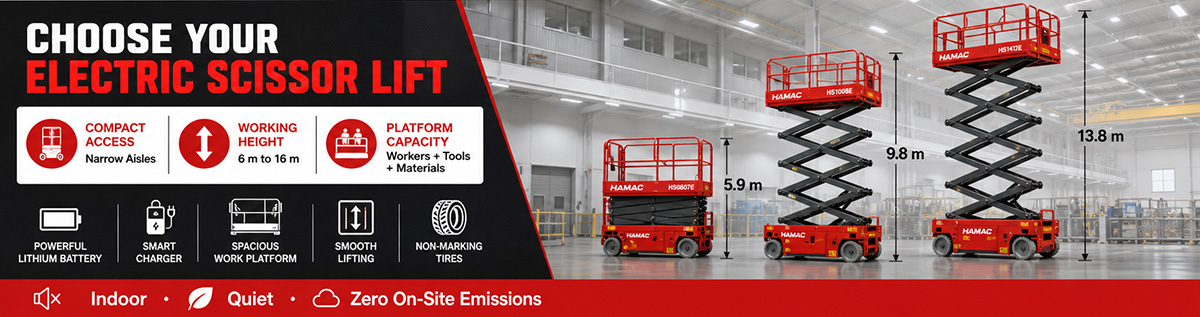
An electric scissor lift is one of the most practical access solutions for warehouses, factories, logistics centers, shopping malls, airports, exhibition halls, workshops, and indoor maintenance projects. It provides vertical access for workers, tools, and approved materials while operating with low noise and no on-site engine exhaust.
However, not every electric scissor lift is suitable for every project. A machine may have enough working height but be too wide for your warehouse aisle. Another model may fit through the doorway but have insufficient platform capacity for two operators and installation materials. The right purchase decision requires more than comparing model names and prices.
Before you buy an electric scissor lift, answer the 10 questions in this guide. They will help you select a machine that matches your working height, platform load, facility layout, battery needs, operating schedule, and long-term service requirements.
Working height is the first specification to confirm. It is the approximate maximum height an operator can reach while standing on the elevated platform. It is commonly calculated as the maximum platform height plus approximately 2 m of operator reach.
For example, an electric scissor lift with an 8 m platform height normally provides approximately 10 m working height. If your warehouse lights, cable trays, or service points are located at 10 m, this machine class may be suitable. However, you should also allow practical room for tools, overhead structures, and comfortable working posture.
| Approximate Working Height | Approximate Platform Height | Typical Indoor Application |
|---|---|---|
| 6 m | 4 m | Low-level maintenance, shelving, cleaning, and retail work |
| 7.8 m to 8 m | 5.8 m to 6 m | Warehouses, workshops, stock work, and lighting maintenance |
| 10 m | 8 m | Factory maintenance, racking work, cable trays, and indoor installation |
| 12 m | 10 m | High warehouse work, HVAC installation, and commercial facilities |
| 14 m | 12 m | High-bay warehouse maintenance and industrial installation projects |
| 16 m or more | 14 m or more | High-ceiling facilities and specialized indoor access projects |
Measure the real work point from the floor where the lift will stand. Do not estimate only from the total building height. Check the height of lights, sprinklers, ducts, cable trays, beams, racking, signs, or the exact maintenance point.
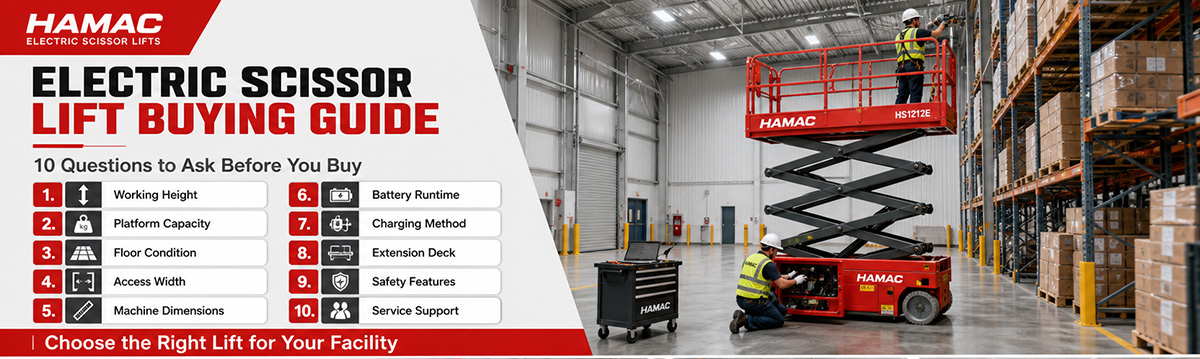
Platform capacity is the maximum combined weight that the elevated platform can safely carry. It includes workers, personal protective equipment, tools, toolboxes, cables, replacement parts, installation materials, and approved accessories.
Do not choose a lift only by the number of people. Two technicians may fit on a platform, but their combined weight with toolboxes, cables, light fixtures, brackets, or other materials may exceed the rated capacity.
Total Required Platform Capacity = Operators + PPE + Tools + Materials + Accessories
| Example Load Item | Example Weight |
|---|---|
| Operator 1 with PPE | 90 kg |
| Operator 2 with PPE | 90 kg |
| Toolboxes and hand tools | 35 kg |
| Power tools and cables | 25 kg |
| Lighting fixtures, brackets, or installation materials | 80 kg |
| Total Estimated Platform Load | 320 kg |
In this example, a standard 230 kg capacity electric scissor lift would not be suitable. A 320 kg, 350 kg, or higher-capacity model may be required, depending on the specific load, platform dimensions, extension-deck limit, and manufacturer instructions.
Electric scissor lifts are usually designed for smooth, firm, and level surfaces. They are ideal for warehouse concrete floors, factory floors, paved loading areas, shopping malls, exhibition halls, workshops, and similar indoor environments.
Before purchasing, inspect the complete travel route and work area. Check for potholes, damaged concrete, floor openings, ramps, drainage channels, dock edges, loose materials, oily surfaces, bumps, steep slopes, and areas with limited floor load capacity.
| Floor or Surface Condition | Electric Scissor Lift Suitability |
|---|---|
| Smooth, level warehouse concrete floor | Suitable for most electric slab scissor lifts. |
| Finished factory floor | Suitable when floor loading and access conditions are confirmed. |
| Shopping mall or exhibition hall floor | Suitable with non-marking tires and careful traffic management. |
| Level paved outdoor area | May be suitable if the machine is approved for the environment and weather conditions. |
| Gravel, loose soil, mud, or uneven construction ground | Not suitable for a standard electric slab scissor lift. |
| Steep slope, trench edge, floor opening, or unstable surface | Do not operate until the area is assessed and made safe. |
An electric slab scissor lift should not be used as a rough terrain machine. If your project includes uneven outdoor ground, gravel, mud, sand, or difficult access routes, consider a rough terrain scissor lift instead.
Access dimensions are often overlooked during purchase planning. A lift may have the correct working height and capacity but be unusable if it cannot pass through the building entrance, warehouse aisle, elevator, loading area, or narrow work zone.
Measure every access point from the unloading location to the final work area. Check doorway width, doorway height, aisle width, turning space, ramp width, elevator size, overhead clearance, loading dock access, and machine storage space.
| Dimension to Check | Why It Matters |
|---|---|
| Overall machine width | Confirms whether the lift can pass through doors, aisles, corridors, and gates. |
| Overall machine length | Determines whether there is enough turning and positioning space. |
| Stowed height | Important for doors, elevators, transport vehicles, and low overhead access. |
| Turning radius | Important for tight corners, narrow warehouse lanes, and congested facilities. |
| Platform dimensions | Confirms whether the platform provides enough workspace for people, tools, and materials. |
| Extension deck length | Helps determine whether limited extra horizontal workspace is required. |
| Machine weight | Must be compatible with floor loading, elevators, ramps, transport trucks, and mezzanines. |
For warehouses, retail facilities, factories, and buildings with restricted access, a narrow electric scissor lift may be the right solution. Compact models are designed to pass through narrow doors, move between storage racks, and work in areas where a larger machine cannot operate efficiently.
Compact models often have a narrow chassis, small turning radius, low stowed height, and non-marking tires. They are useful for maintenance work in warehouse aisles, service corridors, retail locations, workshops, and finished indoor spaces.
However, compact dimensions can also mean a smaller platform, lower capacity, shorter extension deck, or shorter operating time. Always balance access needs with the actual platform workspace and load requirements.
Battery performance affects daily productivity. Before choosing an electric scissor lift, consider how many hours the machine will work each day, how frequently it will be driven and lifted, whether it will carry heavy loads, and when it can be charged.
Occasional maintenance work may only require standard battery capacity and overnight charging. A rental fleet, busy warehouse, facility maintenance department, or multi-shift production site may need longer runtime, faster charging, maintenance-free battery options, or a battery-management plan.
| Operating Pattern | Battery and Charging Consideration |
|---|---|
| Occasional work under 2 hours per day | Standard battery system and scheduled charging may be sufficient. |
| Regular daily maintenance work | Confirm that battery capacity supports the expected shift and daily lift cycles. |
| Frequent lifting and driving during one shift | Consider higher-capacity batteries, efficient AC drive, or a fast-charging solution. |
| Multi-shift operation | Plan charging windows, spare battery strategy where applicable, or lithium battery options. |
| Rental fleet operation | Choose a durable battery system with easy charging, clear battery indicators, and practical service support. |
| High-temperature or dusty environment | Confirm battery and charger suitability for the actual operating environment. |
Also confirm the local voltage, plug type, charger input requirements, charging time, battery maintenance needs, and whether the charger is built into the machine or supplied separately.
An extension deck gives workers additional platform length and limited horizontal workspace. It is useful when the work point is slightly beyond the main platform edge, such as warehouse racking, ceiling cable trays, pipes, ducts, lighting, and maintenance points near a wall or structure.
An extension deck does not replace a boom lift. If the work area requires major horizontal outreach or access over obstacles, an articulating boom lift or telescopic boom lift may be a better solution.
| Application | Extension Deck Benefit |
|---|---|
| Warehouse racking maintenance | Helps operators reach slightly beyond the main platform without repeated repositioning. |
| Ceiling lighting work | Provides additional space for workers and fixtures near ceiling structures. |
| Cable tray installation | Supports access to tray routes that are not directly above the platform center. |
| HVAC ductwork maintenance | Provides extra workspace for tools and components. |
| Wall finishing or interior installation | Helps workers access locations close to walls or structural elements. |
Always check the extension-deck capacity separately. The extension deck may have a lower permitted load than the main platform, so heavy materials should not be placed on the extended section without checking the machine capacity label and operating instructions.
Safety should be part of the purchase decision from the beginning. The required configuration depends on the market, jobsite rules, working height, application, and local regulations. At minimum, buyers should confirm that the machine has the appropriate platform guardrails, entry gate, emergency stop controls, emergency lowering function, braking system, alarms, and safety devices.
| Safety Feature | Why It Matters |
|---|---|
| Guardrails and toe-boards | Help protect workers and reduce the risk of falling objects. |
| Self-closing or secure entry gate | Helps maintain protected access to the elevated platform. |
| Emergency stop button | Allows immediate shutdown of machine functions in an emergency. |
| Emergency lowering system | Allows the platform to be lowered if normal controls or power are unavailable. |
| Tilt alarm | Warns the operator when the machine is operating on excessive slope or uneven ground. |
| Pothole protection | Helps support stability on many electric scissor lift models when elevated. |
| Overload protection | Warns or prevents lifting when |
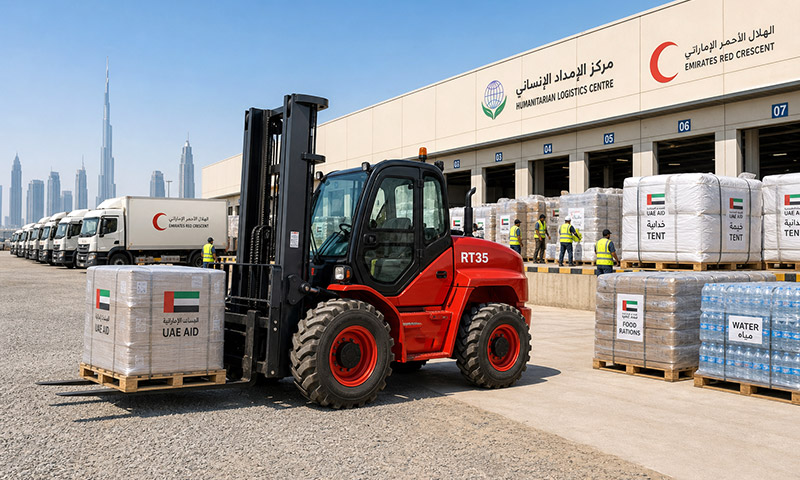
RT35 3.5 ton 4×4 rough terrain forklifts help a humanitarian logistics hub near a major UAE city rec
Free Consultation >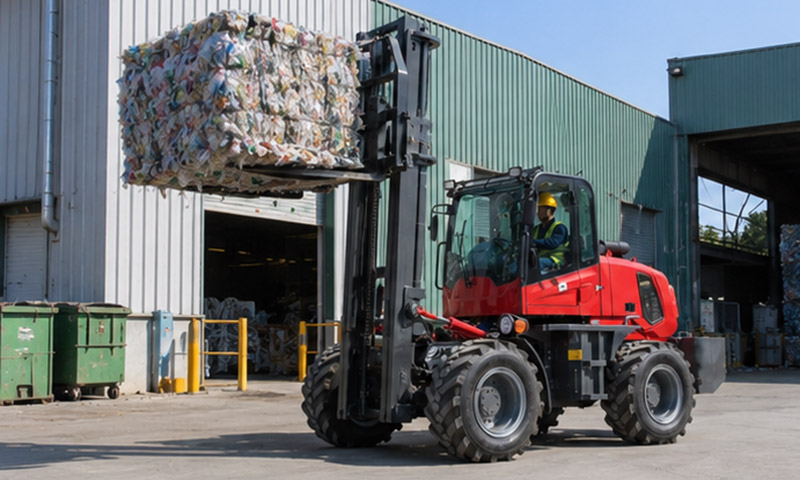
At a recycling plant, a HAMAC FD40-RT articulated rough terrain forklift is used to handle compressed
Free Consultation >
On a metal building project, an HT6018 telehandler is used to handle sandwich wall panels and long ro
Free Consultation >Please fill out the form, and we can satisfy any of your needs including equipment selection, scheme design, technical support, or after-sales service. We will contact you as soon as possible.