Telescopic Lift
Aerial Work Platforms
Max Platform Height: 18.3m–56m
Platform Capacity: 230kg–480kg
Consult now






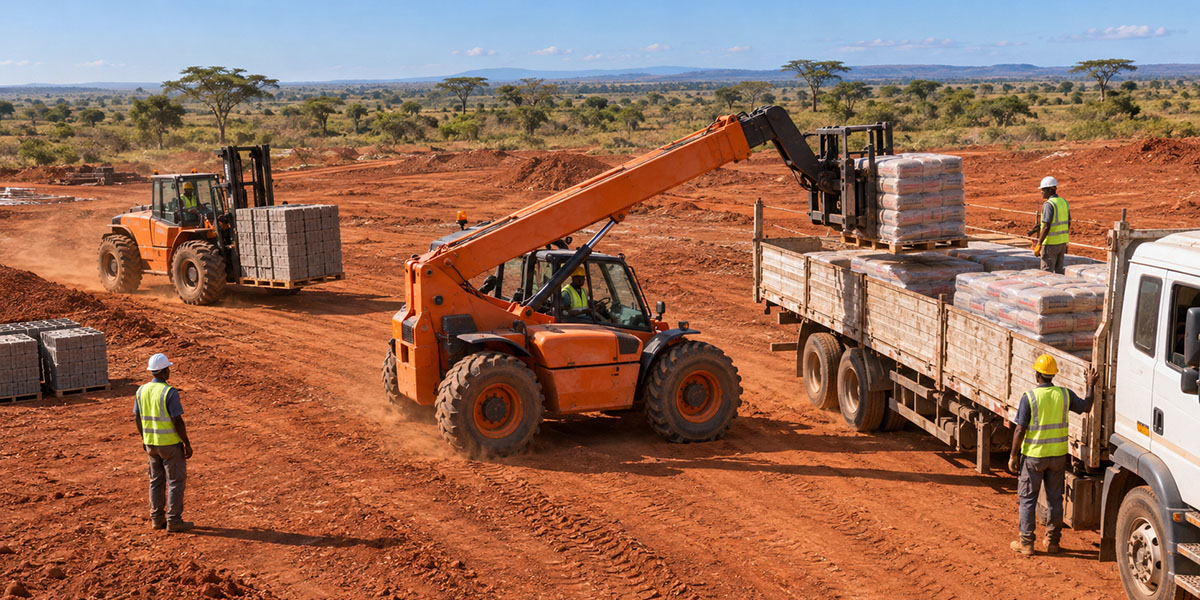
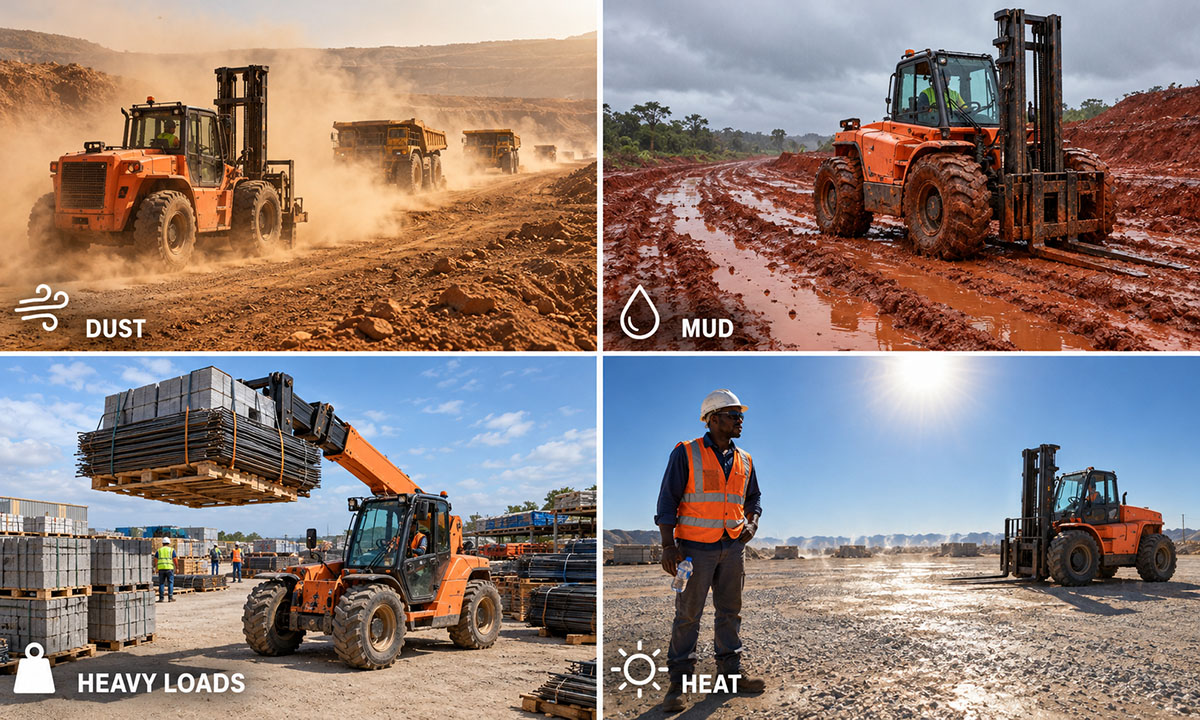
Africa's material handling environment is unlike Europe's or North America's. Laterite haul roads, dry sand, seasonal mud, ambient temperatures above 40°C, dust, unreliable grid power and workshops that may be several hundred kilometers away all change what a machine must survive. Equipment that performs well on a paved European logistics yard can fail in its first African rainy season.
Telehandlers and rough terrain forklifts are both built for unpaved work, but they solve different problems. This guide explains how each machine serves African construction, mining, agriculture and logistics operations, which specifications matter in hot, dusty and remote conditions, and how buyers can plan parts, service and delivery before the first breakdown instead of after.
| Condition | Equipment Requirement |
|---|---|
| Laterite and dry sand surfaces | High ground clearance, wide flotation tires, deep aggressive tread for traction. |
| Rainy-season mud and soft soil | 4WD with differential support, sealed electrical connectors, drainage-aware site routing. |
| Ambient heat above 40°C | Engine cooling margin, hydraulic oil cooler, heat-resistant seals and battery specification. |
| High dust and silica | Two-stage or cyclonic air filtration, sealed cab option, shortened service intervals. |
| Unreliable grid power | Diesel drive as the default; battery charging infrastructure evaluated before any electric machine purchase. |
| Remote workshops and long supply routes | Simple, widely supported components; stocked spare parts; remote diagnostics; documented service intervals. |
Laterite deserves particular attention. It forms a hard cemented crust when dry that demands strong traction and wear-resistant tires, then softens and loses shear strength when saturated, which reduces tire mobility and bearing capacity. A fleet that must work in both wet and dry seasons needs the specifications for the worse case, not the average.
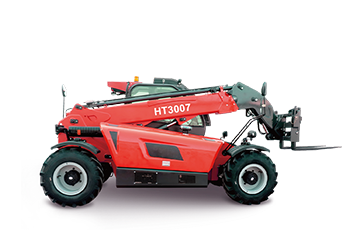
A telehandler's telescopic boom gives it forward reach and lift height that a conventional forklift mast cannot match. In African projects, this translates into specific recurring uses:
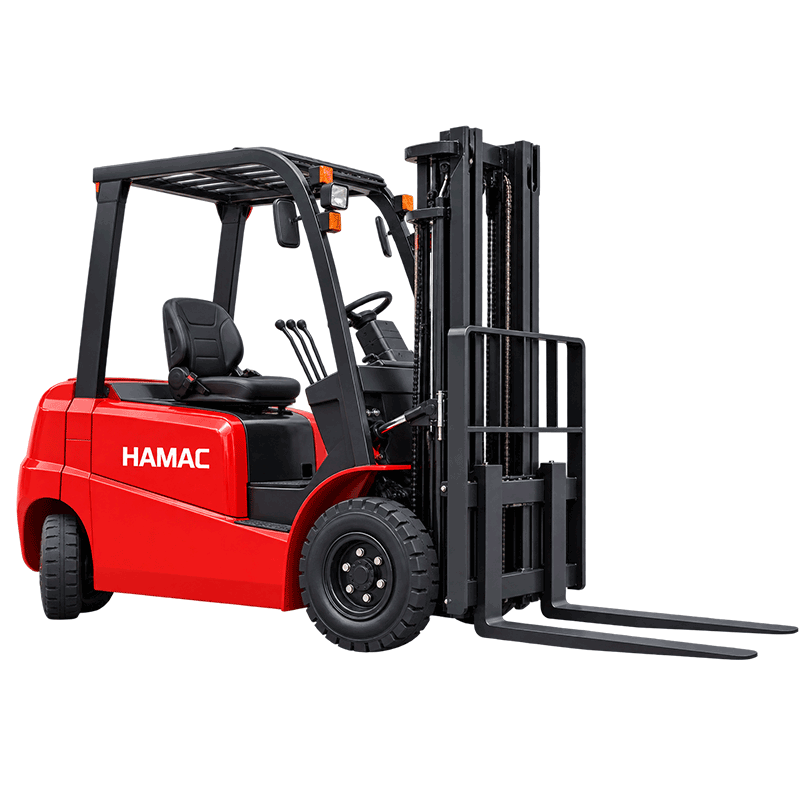
A rough terrain forklift trades reach for raw capacity and lower cost per ton lifted. Typical African uses:
| Criterion | Telehandler | Rough Terrain Forklift |
|---|---|---|
| Lift height | High: up to 18 m on larger models | Moderate: typically 3 m to 6 m mast |
| Forward reach | Yes: boom extends over obstacles and truck beds | No: mast is vertical |
| Typical capacity | 2.5 t to 6 t depending on boom position | 3 t to 10 t at the load center |
| Attachment range | Wide: forks, buckets, hooks, platforms, grapples | Mostly forks, plus approved buckets and clamps |
| Site preparation | Tolerant of unpaved, sloped and rutted ground | Tolerant of unpaved and uneven ground |
| Purchase and running cost | Higher | Lower |
| Maintenance complexity | Boom, hydraulics and attachment plumbing add points to service | Simple mast and chassis, fewer systems |
A useful rule: if your material must reach above roughly 6 m or across an obstacle, specify a telehandler. If it moves horizontally at ground to mid-height and volume matters more than reach, a rough terrain forklift will do the same work at lower cost. For more detail, read our telehandler vs rough terrain forklift comparison.
Downtime cost in remote African operations is not measured in repair invoices but in idle crews, delayed project milestones and penalty clauses. Before ordering, confirm the following with your supplier:
HAMAC ships a spare parts package with new machines and maintains stock of common service items for international customers. For buyers new to this class of equipment, our South America applications guide shows how the same selection logic applies outside Africa.
Most HAMAC machines for African customers move by sea in containers or on flat racks to the main regional ports. Confirm the following before you commit:
| Region | Common Destination Ports | Typical Sea Transit from China |
|---|---|---|
| West Africa | Lagos, Tema, Abidjan, Dakar | Approximately 35 to 45 days |
| East Africa | Mombasa, Dar es Salaam, Djibouti | Approximately 25 to 35 days |
| Southern Africa | Durban, Walvis Bay, Beira | Approximately 25 to 35 days |
| North Africa | Alexandria, Casablanca, Algiers | Approximately 25 to 35 days |
Payment is commonly arranged by letter of credit, telegraphic transfer against shipping documents, or installment terms for established accounts. Confirm export packing, fumigation and any certificate of origin requirements with your clearing agent before the machine leaves the factory, as documentation errors are a frequent cause of port delay.
| Model | Type | Capacity | Lift Height | Typical African Use |
|---|---|---|---|---|
| HT3510 | Telehandler | 3.5 t | 10 m | General construction, scaffold feeding, agricultural bales |
| HT4014 | Telehandler | 4 t | ≈14 m | Multi-storey construction, bridge and infrastructure works |
| HT5014 | Telehandler | 5 t | ≈14 m | Mining support, precast placement, heavy industrial sites |
| FD30-RT | Rough terrain forklift | 3 t | 4.5 m | Building material yards, farms, municipal depots |
| FD50-RT series | Rough terrain forklift | 5 t | 3–4.5 m | Stone yards, timber, cement plants, mining logistics |
For the full range including 10 t rough terrain forklifts and 18 m telehandlers, browse the HAMAC telehandler range and the HAMAC rough terrain forklift range. Final selection should be confirmed against the official specification sheet, rated load, load center, lift height and attachment configuration.
Which telehandler is best for African construction sites?
A 3.5 t to 4 t model with 10 m to 14 m lift height, 4WD and deep-lug off-road tires covers most African construction and infrastructure work. Match the capacity to your heaviest routine load, not the machine's maximum rating.
Can a telehandler work on laterite and sand?
Yes, if it has 4WD, ground clearance above 300 mm and flotation tires with an aggressive tread. Mobility drops on saturated laterite in the rainy season, so plan routes and recovery procedures accordingly.
How long does shipping take to African ports?
Typically 25 to 45 days from China depending on destination port, plus inland transport and customs clearance. Build this into your project schedule and order spare parts with the machine.
Do you provide spare parts support in Africa?
HAMAC ships a starter spare parts package with new machines and stocks common service items for international dispatch. Confirm the specific parts list and lead time for your model before ordering.
Send HAMAC your country, typical ground conditions, heaviest load, required lift height and intended attachments. We will recommend a telehandler or rough terrain forklift configuration, confirm spare parts availability and return a quotation delivered to your nearest port.
Request an Africa Project Recommendation & Quotation
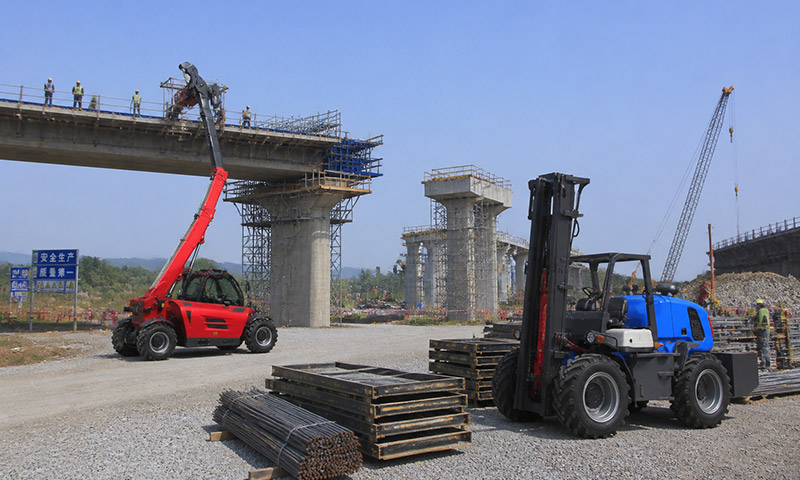
On a bridge construction project, FD50‑RT 5 ton rough terrain forklifts and an HT2506 2.5 ton teleh
Free Consultation >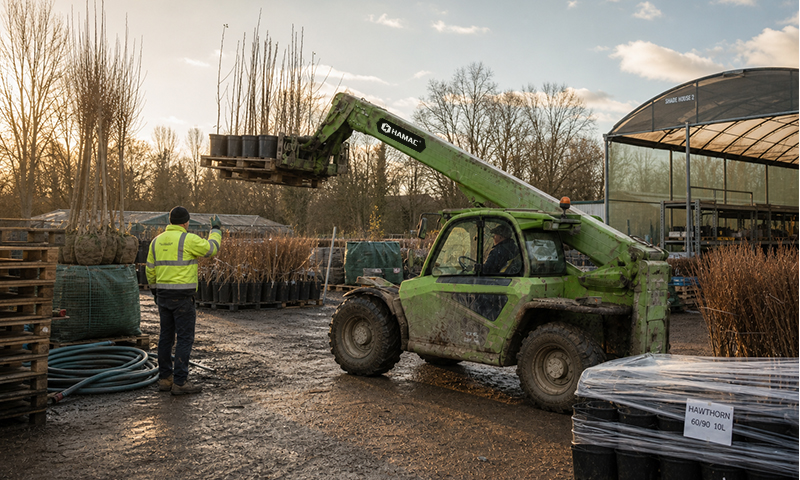
In forestry nurseries and tree logistics, a telehandler is used to move pallets of trees, load outgoi
Free Consultation >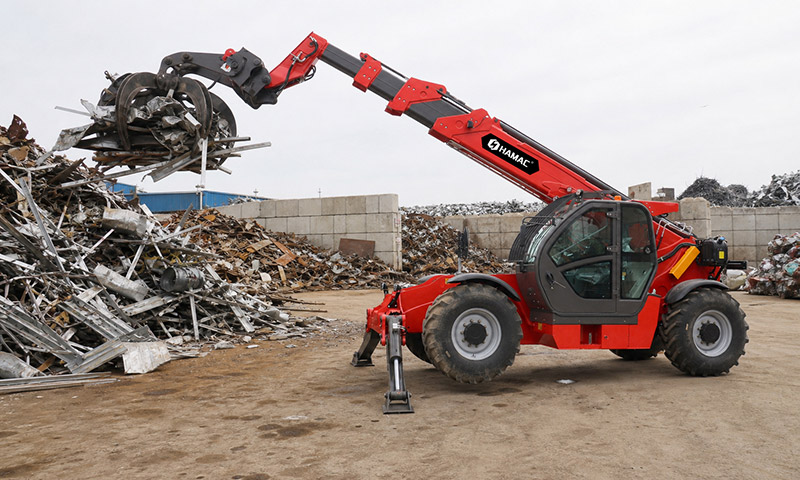
In a metal recycling yard, an HT4018 telehandler is used to sort, stack and load scrap metal and mixe
Free Consultation >Please fill out the form, and we can satisfy any of your needs including equipment selection, scheme design, technical support, or after-sales service. We will contact you as soon as possible.