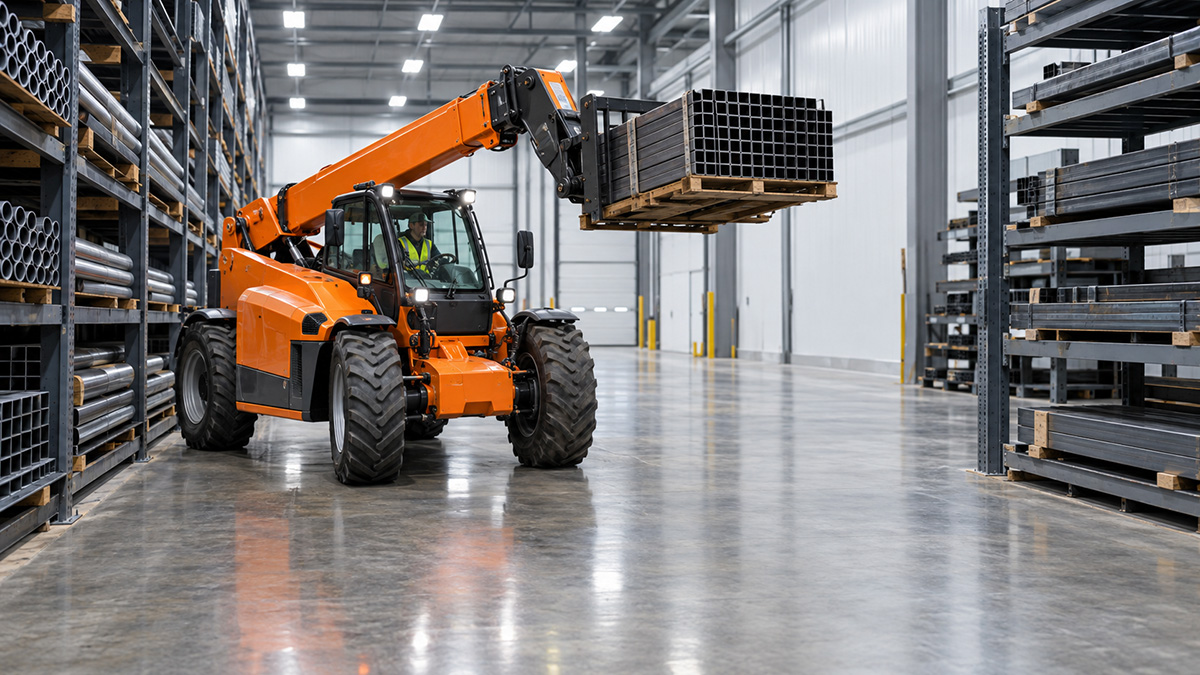
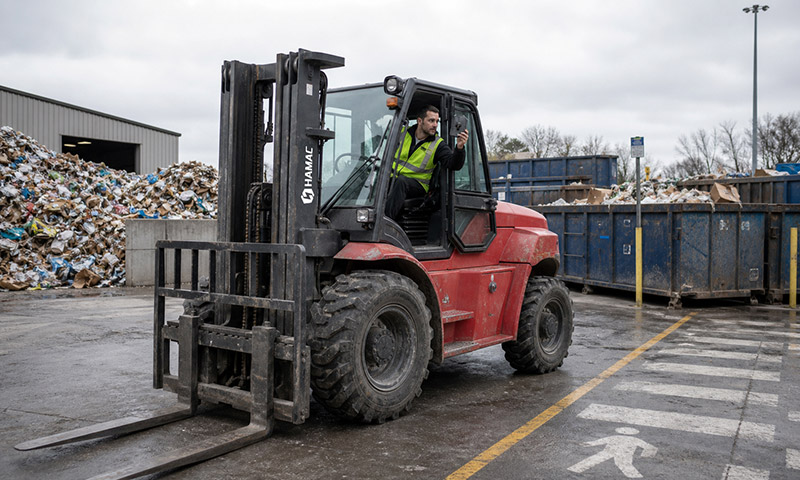
A telehandler's steering mode has to match the site you work on. The same machine that steers freely across an open farmyard cannot turn around in a narrow steel workshop aisle. Steering is not a "higher spec is better" choice. It is a functional selection driven by aisle width, ground conditions and task type. Buy it wrong in either direction and you either own a machine that cannot enter your aisles, or you paid for capability the site never uses.
How Each Steering Mode Works
Telehandlers are offered with three steering configurations. Each changes how the machine rotates, how it tracks and how much of the driveline and hydraulics it exposes to wear.
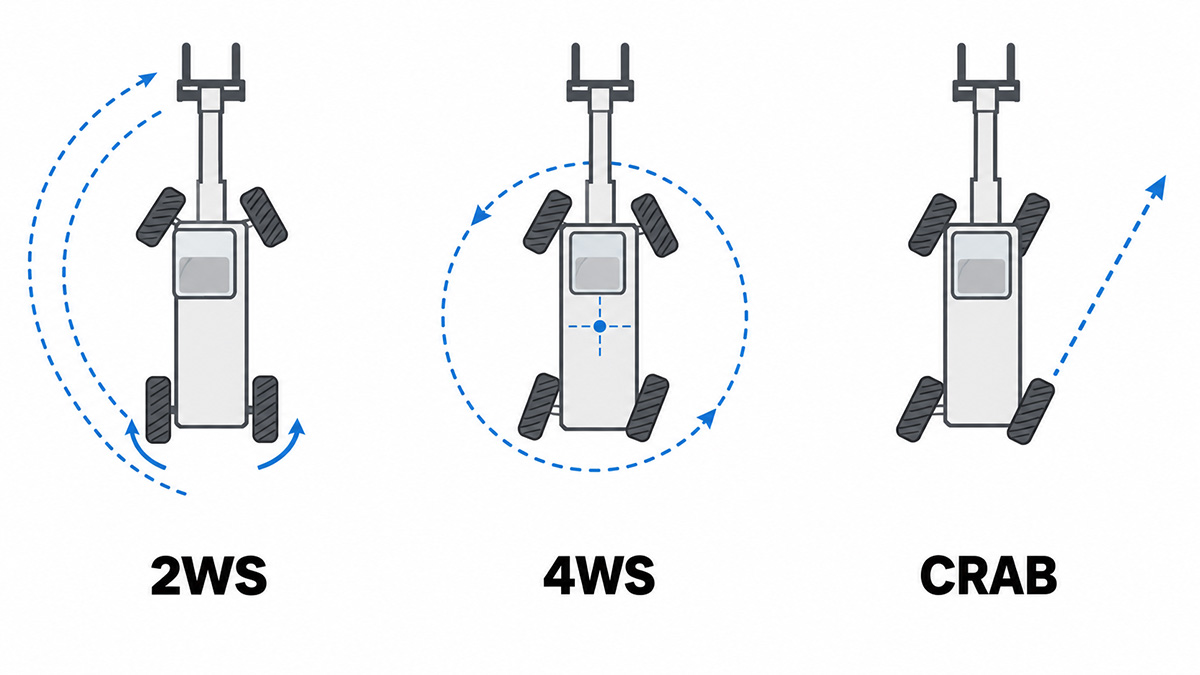
Two-wheel steering (2WS) turns only the front axle. The rear wheels follow. It is the simplest and cheapest layout, with the fewest hydraulic cylinders, sensors and control valves in the steering circuit, and the lowest long-term maintenance burden.
Four-wheel steering (4WS) turns the front and rear axles in opposite directions. Both ends of the machine rotate around a point near its center, which produces the smallest turning circle of the three modes.
Crab steering turns the front and rear wheels in the same direction. The machine does not rotate; it moves sideways or at an angle while keeping its heading. On most modern telehandlers, 4WS and crab are combined in one selectable system, with the operator choosing the mode from the cab.
Turning Radius and Aisle Width Requirements
|
Steering Mode |
Relative Turning Circle |
Typical Aisle Needed |
Best Suited Site |
|
2WS |
Baseline, largest |
Widest |
Open yards, farms, quarries, timber decks |
|
4WS |
Smallest, often 30%+ tighter than 2WS |
Narrowest |
Steel workshops, dense yards, urban retrofit, barn aisles |
|
Crab |
Not a turning mode; moves machine sideways |
Depends on load path |
Wall-line work, slope approach, precise load alignment |
Exact turning circles vary by wheelbase, tire size and boom position, so request the figure for your specific model rather than a class average. For a full model list with dimensions, see the HAMAC telehandler range.
Where Each Mode Excels: Application Mapping
2WS is the default for open work. Farms, aggregate yards, timber decks and building sites with room to maneuver get no practical benefit from 4WS, and take on its extra service points for nothing. If your aisles are wider than the machine plus a loaded pallet plus a safety margin, 2WS is the economical choice.
4WS earns its price where the machine must turn inside a restricted footprint: precast yards with racks on both sides, steel fabrication shops, urban infill projects, dairy and livestock buildings. Each avoided three-point turn saves time, reduces tire scrub and lowers the risk of contact damage.
Crab steering solves positioning problems that turning cannot. Move a machine sideways along a wall to place panels, align a load with a bolt line without re-approaching, or take a slope at an angle so the load stays level across the grade.
Crab Steering on Slopes: Real Benefit, Real Limits
On a cross slope, a telehandler driven straight has one side of the chassis higher than the other. Crab steering lets the operator angle the machine so the chassis stays closer to level while it travels across the grade. This reduces the sideways component of the load and improves stability on gentle slopes.
This is a positioning aid, not a slope license. Crab mode is for slow, deliberate movement. High-speed travel in crab, and any loaded travel across a steep side slope, remain prohibited regardless of steering mode. Stability on grades is governed by the load chart, tire condition and ground assessment, not by which steering mode is selected. For daily ground and machine checks, use our telehandler daily inspection checklist.
Can You Add 4WS to an Existing Telehandler
Retrofitting four-wheel steering to a two-wheel steer machine is rarely practical. The rear axle must be replaced with a steerable unit, a second hydraulic circuit added, sensors and a controller installed and the software calibrated. On most machines this costs more than the price difference to a factory 4WS unit, and it can void the warranty. Decide the steering configuration at purchase, based on the aisle widths and tasks the machine will actually work in.
Choosing the Right Steering Configuration for Your Site
-
Measure your narrowest working aisle, including the pallet or load width.
-
Request the turning circle data for each candidate model in the steering modes it offers.
-
List the tasks: turning in restricted aisles points to 4WS; sideways positioning or slope crossing points to crab.
-
Confirm your maintenance team can service the rear steering loop, or budget for dealer service.
-
Match the choice to the site the machine will spend most hours on, not to the most demanding job it might do once a year.
Frequently Asked Questions
What is crab steering on a telehandler?
Crab steering turns the front and rear wheels in the same direction so the machine moves sideways or at an angle without changing its heading. It is used for positioning along walls, aligning loads and crossing gentle slopes.
What is the difference between 2WS and 4WS on telehandlers?
2WS turns only the front axle and has the largest turning circle and the fewest service points. 4WS turns both axles in opposite directions, produces a much tighter turning circle and adds rear steering hydraulics and controls.
Does four-wheel steering reduce turning radius?
Yes. By rotating around a point near the machine's center instead of its rear axle, 4WS typically reduces the turning circle substantially compared with 2WS on the same wheelbase. Request the exact figure for your model.
Is crab steering safe on slopes?
As a slow positioning aid on gentle grades, yes. It is not a license for fast travel or for loaded work on steep side slopes. Stability is governed by the load chart, tires and ground condition.
Can I add 4WS to my telehandler later?
Rarely. A retrofit needs a steerable rear axle, a second hydraulic circuit, sensors, a controller and calibration, usually costing more than the factory option and risking the warranty. Choose at purchase.
Get a Steering Configuration Recommendation
Send HAMAC your narrowest aisle width, typical load dimensions and the tasks the machine will perform. We will confirm which steering configuration fits your site and quote the machine with the correct setup from the factory.
Request a Steering Configuration & Quote